From expertise to action: contributing to Europe’s next CCS research agenda
Share this page
Europe has ambitious plans for industrial carbon management. Delivering them will require continued research and innovation, and clear choices about where European R&I can make the greatest difference.
Illustration of offshore CO₂ storage and monitoring
Europe is moving from individual CCS projects towards industrial carbon management at much greater scale.
That means capturing CO₂ from hard-to-abate industries, developing transport networks across regions and borders, bringing significantly more geological storage capacity online, and developing carbon removal solutions that can contribute to climate neutrality.
But setting deployment targets is not the same as knowing how to achieve them.
Capture technologies still need to become more efficient and less costly. Transport systems need to work safely and flexibly across different sources and destinations. Storage capacity needs to be characterised and developed faster, while reducing uncertainty and risk. Carbon removal pathways need further development. And deployment raises societal, regulatory and economic questions alongside the technical ones.
Continued research and innovation is therefore not separate from Europe’s industrial carbon management ambitions. It is one of the things that will determine whether they can be delivered.
From European ambition to a research agenda
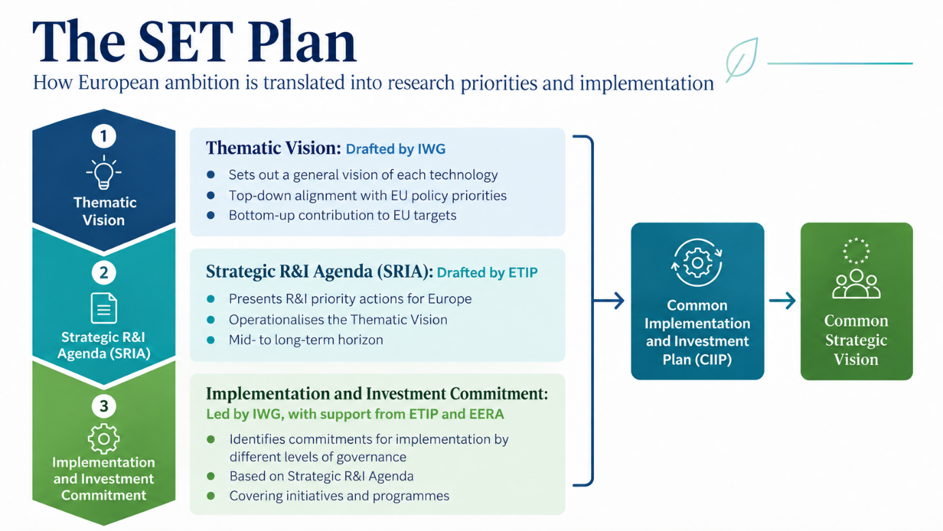
This is where the European Strategic Energy Technology Plan — the SET Plan — comes in.
The SET Plan is a framework for coordinating research and innovation between European countries, industry and the research community. One of its central purposes is to align national R&I efforts with shared European energy and climate objectives.
For industrial carbon management, the Implementation Working Group 9 (IWG9) brings together SET Plan countries, the European Commission and other stakeholders around the development and deployment of the technology.
The process can be simplified into a few steps.
IWG9 establishes a Thematic Vision: where Europe needs to go.
That vision is then translated into a Strategic Research and Innovation Agenda (SRIA): what needs to be researched, developed and demonstrated to help Europe get there.
Carbon Management Europe (CME), which supports the European Technology and Innovation Platform for industrial carbon management under the SET Plan, coordinates the overall SRIA process.
EERA JP CCS has a specific role within that wider process: bringing together the perspective and expertise of the European research community and contributing research priorities into the developing agenda.
How Europe’s research community is shaping the priorities
That contribution has not been developed by a handful of people around a table.
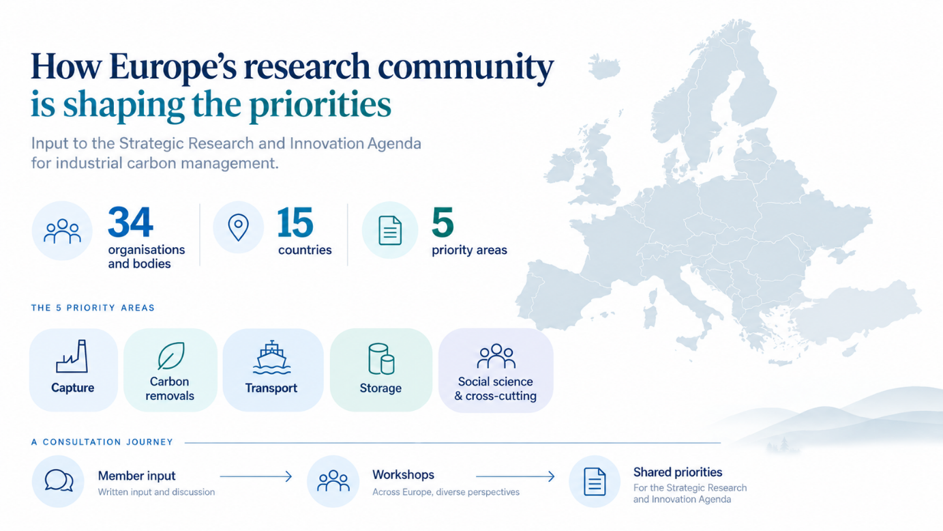
It has grown through a wider consultation process: discussions around knowledge gaps and research needs, work within the EERA JP CCS Steering Committee, engagement with members, an open invitation to contribute additional research topics, and more recently a series of deeper workshops across different parts of the industrial carbon management system.
So far, 34 organisations and bodies across 15 countries have been represented in the EERA JP CCS consultations.
Researchers have examined capture and carbon dioxide removal, transport and storage, alongside societal and other cross-cutting research questions.
The purpose is not simply to approve an existing list of priorities.
It is to challenge it.
What is missing? Which problems are most urgent? What needs to happen first? Which developments depend on progress elsewhere? And where does Europe need better evidence, new knowledge or further demonstration before technologies can move forward?
These questions matter because industrial carbon management is a system.
Capture affects transport. CO₂ specifications can affect both transport and storage. The availability of suitable storage can determine whether capture projects proceed at all. Energy use, infrastructure, regulation and public acceptance cut across the value chain.
A useful research agenda has to recognise those connections.
From storage targets to research questions
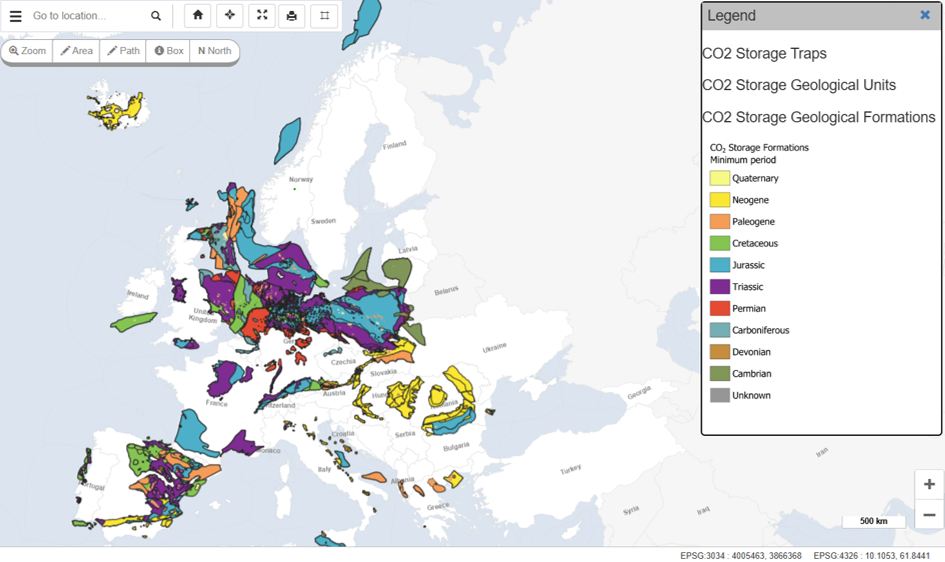
CO₂ storage provides one example of what this looks like in practice.
Europe has set a target of at least 50 million tonnes of annual CO₂ injection capacity by 2030. But the target itself does not tell us what needs to be solved to make that capacity available.
The research discussions therefore move several levels deeper.
How can promising storage resources be assessed and matured more quickly? How can uncertainty in geological data be reduced? What happens as multiple storage projects begin operating within the same regions and interacting through subsurface pressure? How should legacy wells be assessed? Can monitoring become more efficient without compromising confidence in permanent storage? How can injection rates and storage capacity be improved?
Researchers are also considering how artificial intelligence and advanced analytics could accelerate geological screening, help unlock historic datasets and improve the management of uncertainty.
None of these individual questions is the European storage target.
Together, however, they help establish the knowledge base needed to reach it.
The same principle applies across capture, transport, carbon removals and the wider system.
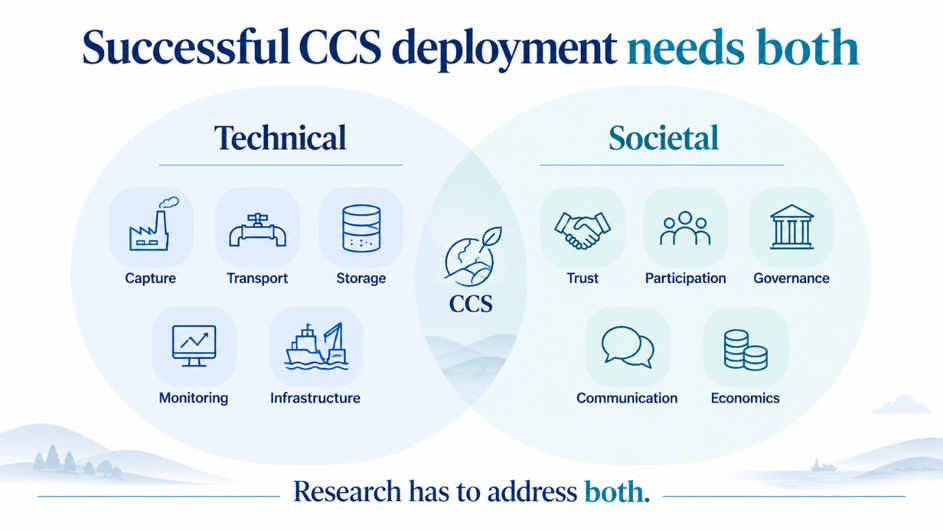
The research questions are not only technical
Successful deployment also depends on understanding people, institutions and society.
Social sciences and humanities are therefore part of the developing research priorities.
The consultation is considering questions around public perception and participation, trust and communication, governance, risk, economics and the wider political context in which industrial carbon management will be deployed.
That is not an optional addition to the engineering.
Technically sound projects can still encounter delays, redesign or cancellation when societal questions are not sufficiently understood. Research can help establish better approaches to community engagement, risk governance and communication, and help build the evidence needed for informed decision-making as infrastructure expands.
It is another example of why the research agenda needs perspectives from across disciplines, not only from individual technologies.
Making European expertise count
Europe already has substantial expertise in carbon capture, transport, storage and carbon removals.
Much of that expertise sits within individual universities, research institutes, projects and national research programmes.
The value of coordinating at European level is in connecting those pieces.
Researchers working in different countries encounter different geology, infrastructure, industrial conditions, policy environments and deployment challenges. Bringing those perspectives together makes it possible to compare experience, challenge assumptions and identify where shared research efforts can have the greatest impact.
This is also a continuation of work already undertaken through the SET Plan. Previous updates to the IWG9 R&I targets have sought to keep European research aligned with a changing policy and deployment landscape. As EERA JP CCS coordinator Marie Bysveen has previously argued, coordinated R&I is critical if Europe is to turn its position in industrial carbon management research into both successful deployment and long-term competitiveness
Marie Bysveen, Coordinator of EERA JP CCS
What happens next?
The priorities are still being developed.
EERA JP CCS will continue working with its research community to refine the research gaps and priorities identified through the consultation and contribute them into the formal SRIA process coordinated by Carbon Management Europe.
From there, the challenge becomes implementation.
The SRIA is not intended only to inform activity at European Commission level. Delivering a coordinated European research effort will also depend on engagement from European countries and on research and innovation programmes at both European and national level reflecting the priorities that emerge.
That brings the process back to where it started.
Europe has set ambitious targets for industrial carbon management. Reaching them requires knowing what still needs to be learned, developed, demonstrated and improved — and coordinating research effort around those needs.
Connect the expertise. Challenge the priorities. Build the evidence Europe needs to move forward.
Login as an EERA member
In case you are an EERA member and don’t have login details, please contact a.schneider@eera-set.eu
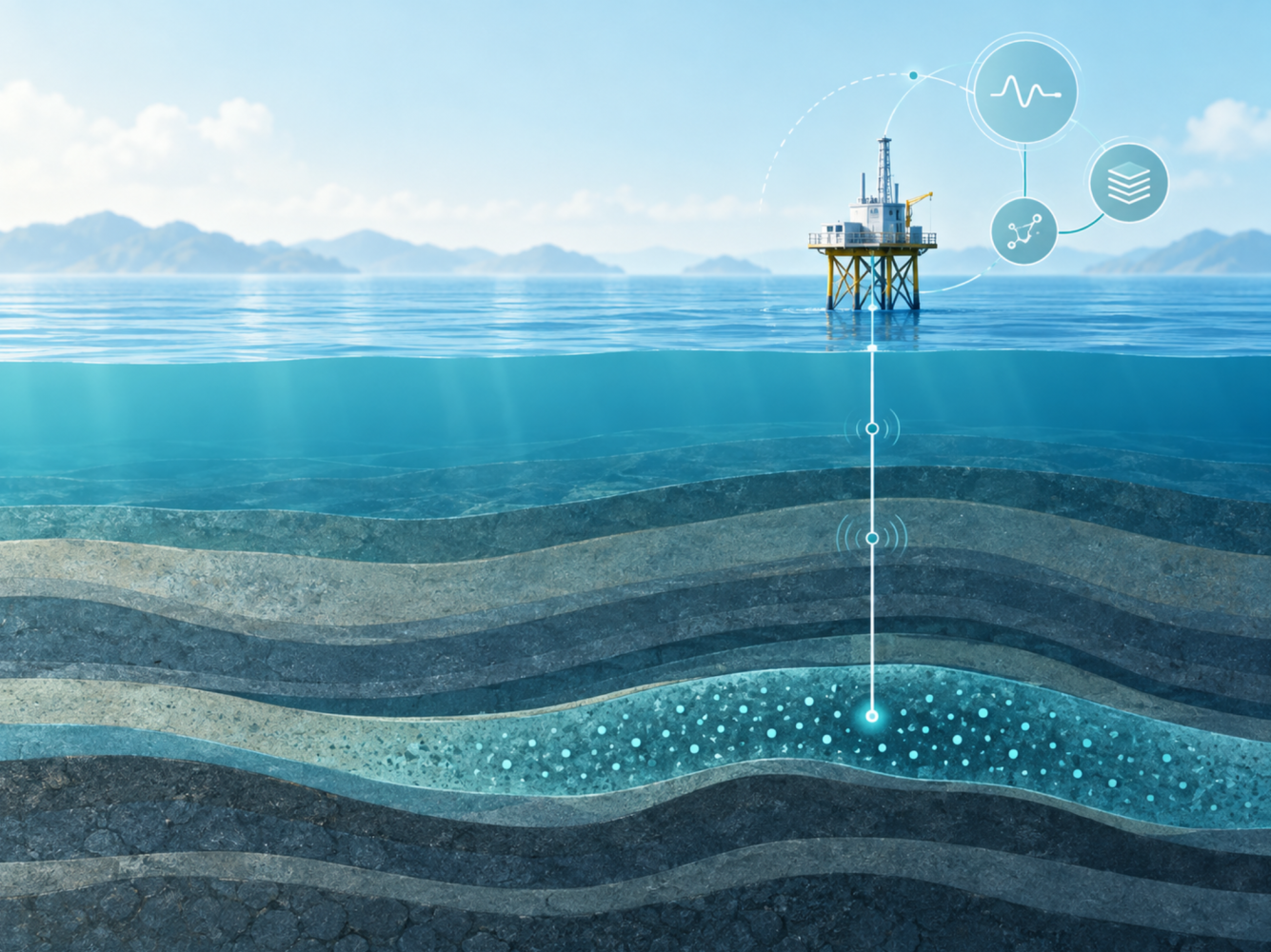 Illustration of offshore CO₂ storage and monitoring