Turning CO₂ into Stone (and Mining for the Future): The Dual Power of CO₂ Mineralization
Share this page
When we talk about Carbon Capture and Storage (CCS), the conversation often revolves around injecting CO₂ deep underground into depleted gas fields or saline aquifers. But what if we could permanently turn CO₂ into rock above ground—and simultaneously extract the critical minerals we need to build solar panels, wind turbines, and electric vehicles?
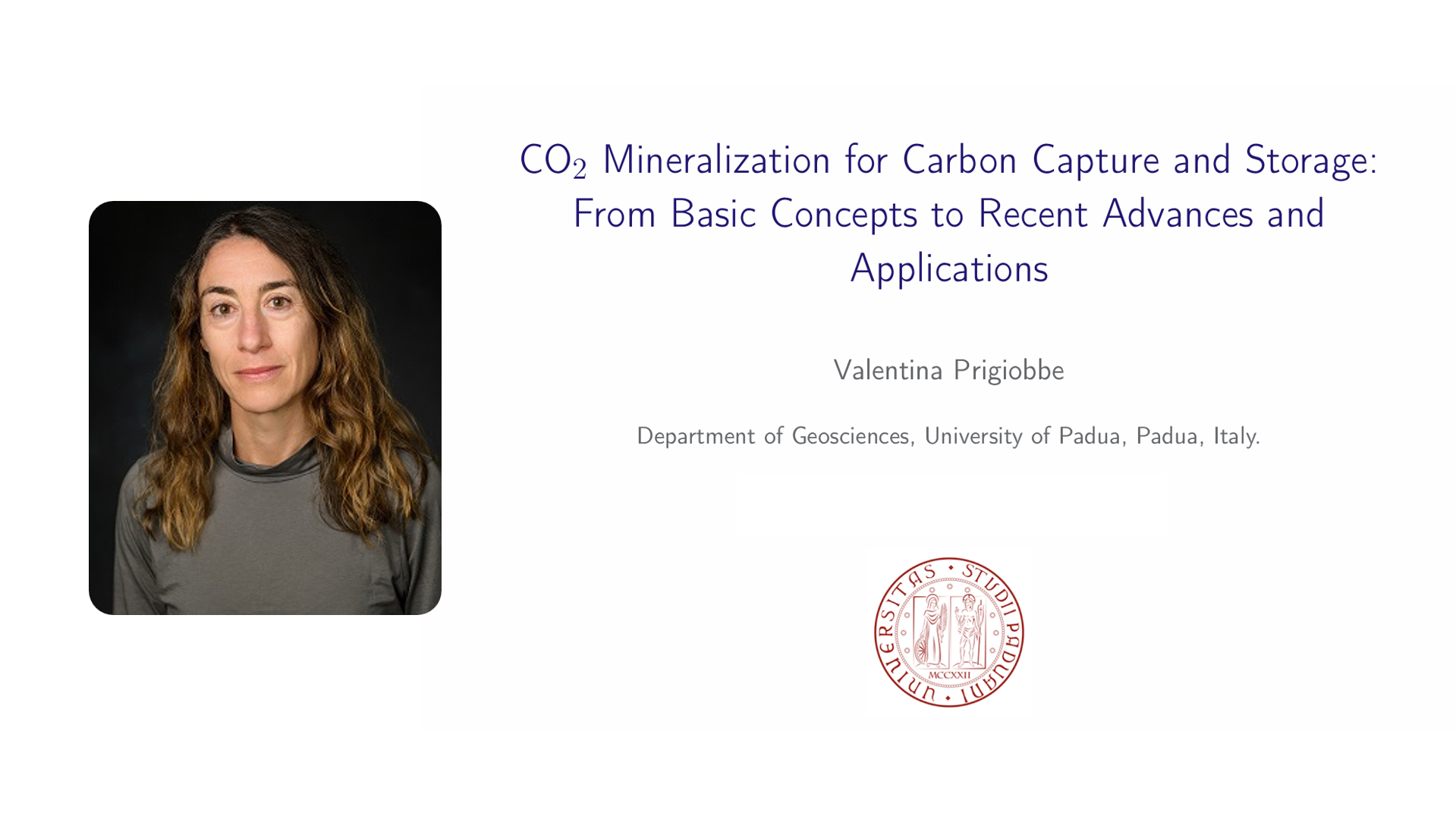
In our latest EERA JP CCS webinar, we had the privilege of hosting Valentina Prigiobbe, Assistant Professor in the Department of Geosciences at the University of Padua. She took us to the cutting edge of a technology that is blossoming in the R&I space: CO₂ Mineralization.
For policymakers, industry leaders, and researchers looking for the next frontier in climate neutrality, here is why CO₂ mineralization is a space you need to watch.
Nature’s Way, Only Faster
At its core, CO₂ mineralization mimics the earth’s natural weathering process. In nature, rocks rich in alkaline metals (like olivine or basalt) slowly react with CO₂ to form stable carbonates—permanently locking the carbon away as a solid mineral.
While nature takes thousands of years to do this, engineers and geoscientists are speeding it up.
There are two main ways to do this:
In-situ (Underground): Injecting CO₂ directly into reactive rock formations underground (like the famous CarbFix project in Iceland), where it mineralizes over a few years.
Ex-situ (Above ground): Bringing the reactive minerals to an industrial plant and reacting them with CO₂ in reactors. This can happen in a matter of hours or days.
The "Double Win" of Mine Tailings
While ex situ mineralization is incredibly fast and easily monitored, it historically faced a major hurdle: the energy and cost required to mine, grind, and pre-treat the rocks.
This is where Valentina’s research shines a light on a massive opportunity: Industrial Waste and Mine Tailings.
Instead of mining new rocks, what if we used the billions of tons of alkaline waste already sitting at mining sites around the world?
Valentina’s research explores a fascinating "Dual Valorization" process. By treating mine tailings with engineered fluids (like organic acids), we can do two incredible things at once:
Extract calcium and magnesium to react with CO₂, creating solid carbonates that can be sold as sustainable building materials (like supplementary cementitious materials for the construction industry).
Recover Critical Elements (CEs) such as titanium, manganese, nickel, and aluminium—materials that are desperately needed for Europe's renewable energy transition and are often trapped inside these very same mine tailings or even dissolved in brines.
The R&I Horizon: What do we need next?
As we look toward Europe's 2050 climate goals, CO₂ mineralization proves that climate mitigation doesn't have to be a sunk cost; it can be a highly productive part of the circular economy.
However, to move from the lab to megaton-scale impact, the R&I community faces several priorities that will likely define upcoming European funding calls:
Process Intensification: Finding better catalysts and optimizing the kinetics to make the reactions faster and less energy-intensive.
Pilot Demonstrations: Moving these integrated processes out of the lab and into 1-10 ktCO₂/year pilot plants.
Value-Added Products: Developing the market and regulatory frameworks for the resulting carbonated building materials.
A Seat at the Table
At EERA JP CCS, our mission is to ensure that excellent, lower-TRL public research like this isn't left behind closed doors, but is actively connected to the policymakers and industry partners who can help scale it.
If your institution is conducting research in the CCUS space and you want to be part of Europe’s largest low-carbon energy research network—shaping the EU R&I agenda and finding the right consortium partners—we invite you to connect with us.